

ThinkTac
Grade IV Annual Math Programme
Grade IV Annual Math Programme
Couldn't load pickup availability
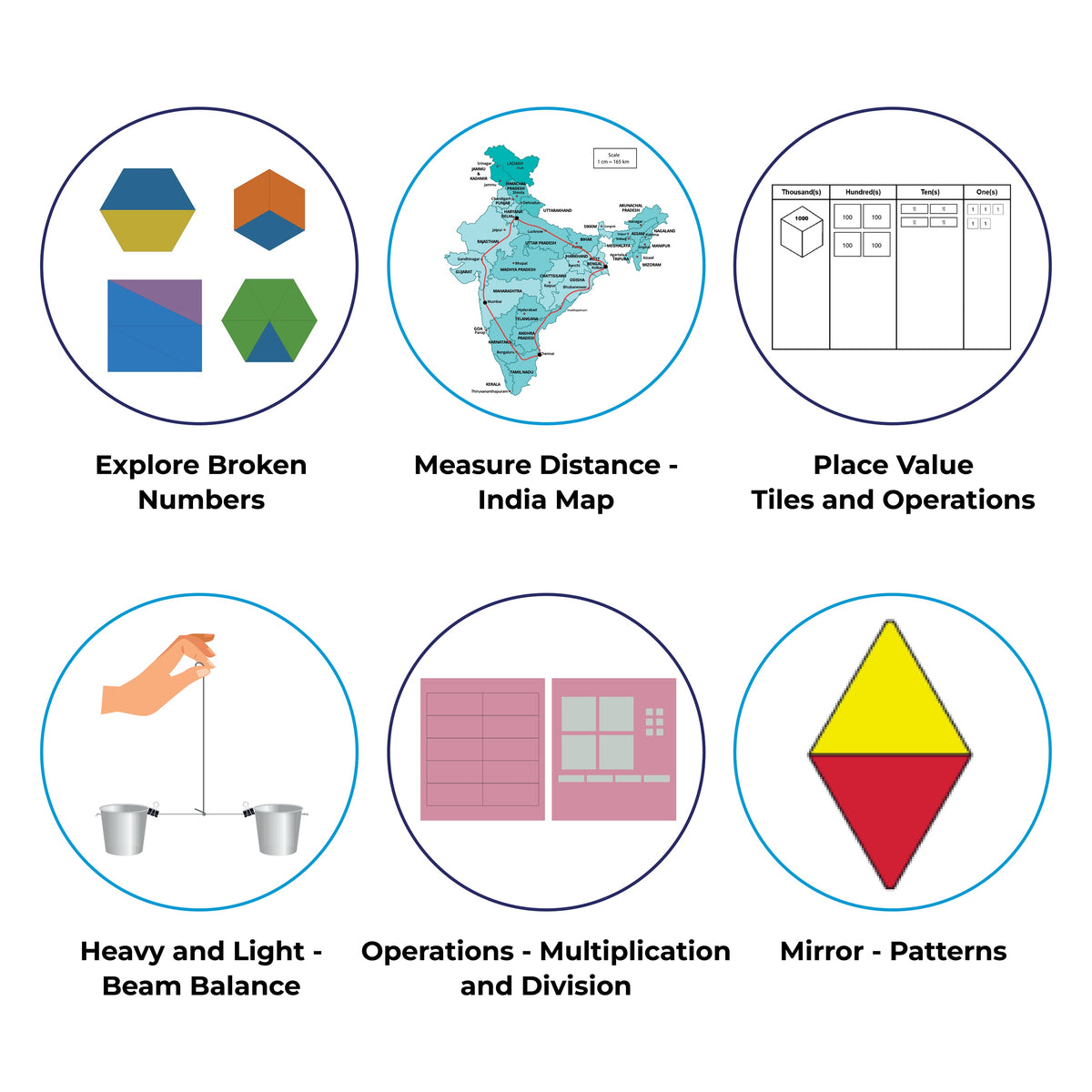
Create, enjoy and learn from ThinkTac's Experiential Science Annual Programme, aligned with the NCERT curriculum, which is fun-filled and can be done safely at the comfort of your home. These do-it-yourself activities are not only cool but also help you better understand what you are learning in your classroom for the year 2024-25. Please note that live facilitation will not be offered; however, in case of any questions or doubts, students can contact us on WhatsApp or by email.
Programme Features:
- Material kit to make six activities will be shipped to your home.
- A activity handbook with DIY guide, hypothesis, observation and inference worksheets is included in the package.
- In case of any questions or doubts, students can contact us on WhatsApp or by email.
- You can join unLab, our online platform, to access videos and additional content
| SL | TACtivity | Concept Covered |
|---|---|---|
| 1 |
Explore Broken Numbers |
Halves and quarters are the portions of a whole, and whole means the entire thing. An entire pizza, a complete birthday cake, an entire chocolate bar, etc., are examples of the whole. Understanding halves and quarters helps us divide things equally and describes how much of something we have. It's like cutting a pizza into slices to share with friends or dividing a shape into equal parts in maths. In this TACtivity, we use different geometrical shapes to understand parts of the whole. |
| 2 |
Measure Distance - India Map |
Maps are useful for more than just finding directions. They can also help us to determine the distance between two cities (or any other points of interest on a map). Maps can have different scale factors. The distance between two points on the map have to be multiplied by this scale factor to get the actual distance between those two points. Here's a TACtivity on how to measure distances on a map using a ruler and thread. |
| 3 |
Place Value Tiles and Operations |
Addition and subtraction are basic operations that help us find totals and differences. Addition means putting numbers together to make a bigger number, while subtraction means taking away to find what is left. In this TACtivity, you will use number tiles to solve addition and subtraction problems in a hands-on way. |
| 4 |
Heavy and Light - Beam Balance |
A beam balance is a type of scale that uses a beam with weights suspended from its ends to measure the mass of an object. In this TACtivity, we build a beam balance and use it to compare the mass of different sized objects with a known weight. |
| 5 |
Operations - Multiplication and Division |
Multiplication and division are two operations that are fundamental in solving a wide range of mathematical problems and are essential building blocks for more advanced mathematical concepts. In this TACtivity, we use 2D tiles to perform multiplication and division operations. |
| 6 |
Mirror - Patterns |
Symmetry is when two parts of a shape match each other perfectly, like looking into a mirror. When light reflects off a mirror, it creates an image that looks just like the object placed in front of it. This reflection helps us see how shapes can repeat, flip, or form balanced patterns. In this TACtivity, you will use a mirror and puzzle pieces to explore how symmetrical patterns are created. |