

ThinkTac
Grade V Annual Math Programme
Grade V Annual Math Programme
Couldn't load pickup availability
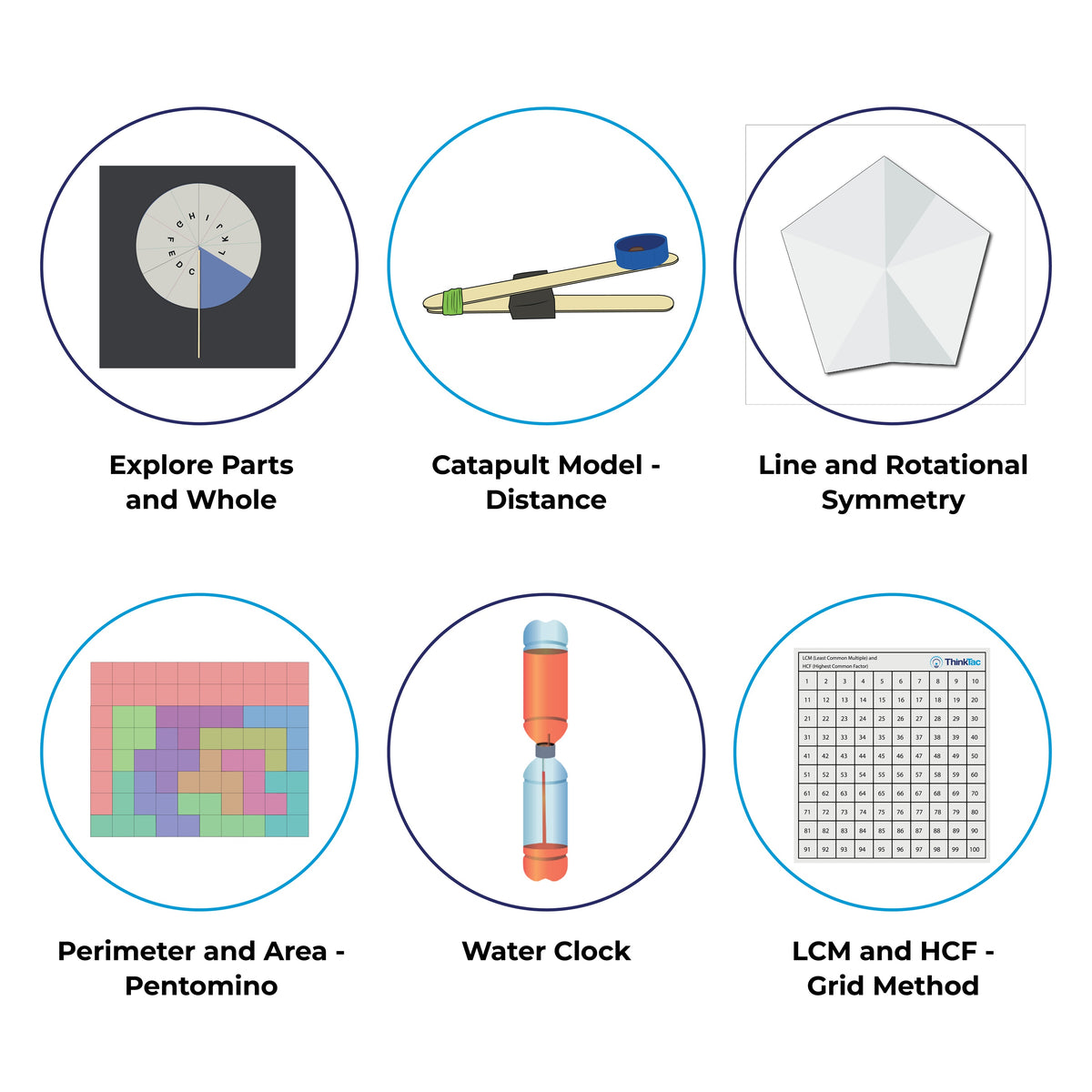
Create, enjoy and learn from ThinkTac's Experiential Science Annual Programme, aligned with the NCERT curriculum, which is fun-filled and can be done safely at the comfort of your home. These do-it-yourself activities are not only cool but also help you better understand what you are learning in your classroom for the year 2024-25. Please note that live facilitation will not be offered; however, in case of any questions or doubts, students can contact us on WhatsApp or by email.
Programme Features:
- Material kit to make six activities will be shipped to your home.
- A activity handbook with DIY guide, hypothesis, observation and inference worksheets is included in the package.
- In case of any questions or doubts, students can contact us on WhatsApp or by email.
- You can join unLab, our online platform, to access videos and additional content
| SL | TACtivity | Concept Covered |
|---|---|---|
| 1 |
Explore Parts and Whole |
Parts are the smaller pieces or components that come together to form a whole. We use the concept of parts and whole to understand how things are made up of smaller pieces and how those pieces fit together to create something larger. This idea is used in many areas of maths, science, and everyday life to help us understand and solve different problems. In this TACtivity, using two discs, we can understand various fractions of a whole. |
| 2 |
Catapult Model - Distance |
A catapult is a simple machine that uses stored energy to launch objects into the air. It was used in ancient times to throw stones, darts, arrows, etc., over long distances. In this TACtivity, we use ice cream sticks and a foam piece to make a catapult, to understand the concepts far and near using different loads. |
| 3 |
Line and Rotational Symmetry |
Symmetry means a shape looks the same on both sides when you fold it along an imaginary line called a line of symmetry. Some shapes also look the same when you turn them around a central point. This is called rotational symmetry. In this TACtivity, you will make different polygons by cutting folded paper with a single cut. Then you will explore each polygon to find its lines of symmetry and check how it looks when you rotate it. |
| 4 |
Perimeter and Area - Pentomino |
Pentomino puzzles challenge players to arrange a set of 12 distinct shapes made of five connected squares each into larger rectangles, fostering spatial reasoning and problem-solving skills. Perimeter and area are fundamental concepts in geometry that help us quantify and describe the size and shape of various two-dimensional geometric shapes. In this TACtivity, we use pentomino pieces and the unit tiles to form different shapes to find the perimeter and area of the shapes formed. |
| 5 |
Water Clock |
Time is one of the fundamental units of measurement. A water clock is a timepiece used to measure time by allowing water to flow out of a container through a tiny aperture. Invented in ancient Egypt, water clocks are one of the oldest time measuring instruments. In this TACtivity, we will make a simple water timer using a couple of bottles and straw pieces that can be set for one-to-five-minute periods. |
| 6 |
LCM and HCF - Grid Method |
Least Common Multiple (LCM) and Highest Common Factor (HCF) are fundamental concepts in the number system and play essential roles in various calculations. They are used in various mathematical and real-world applications. In this TACtivity, we use a number chart and coloured kundans to find the LCM and HCF of the given numbers. |