

ThinkTac
Grade VI Science Kit for Children (Class 6) - 6 Hands-on Experiments, NCERT Aligned
Grade VI Science Kit for Children (Class 6) - 6 Hands-on Experiments, NCERT Aligned
For the 2026-27 academic year
Couldn't load pickup availability
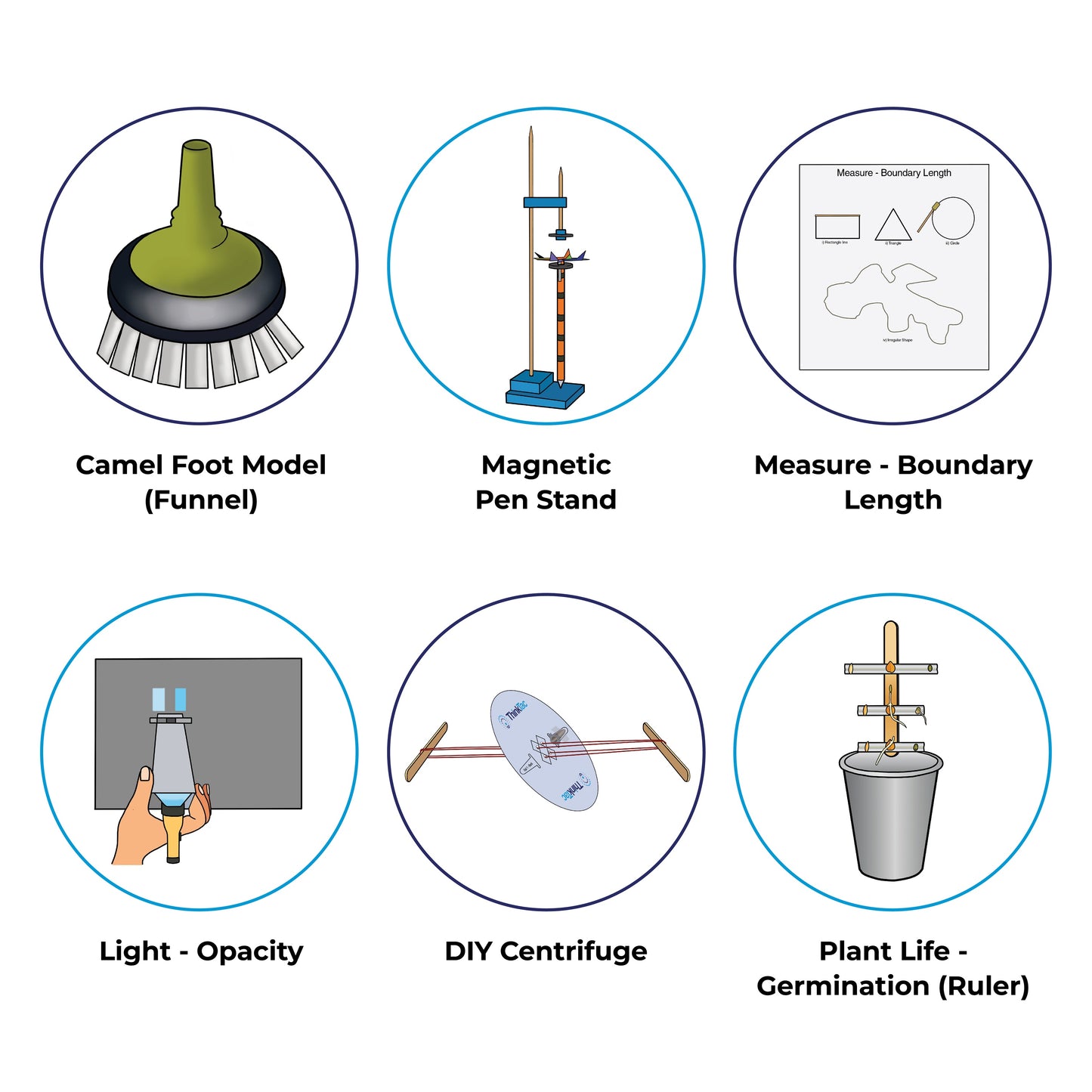
A hands-on science experiment kit for children in Grade VI (Class 6). It has the materials for six do-it-yourself science experiments at home: Camel Foot Model, Magnetic Pen Stand, Measure - Boundary Length, Light - Opacity, DIY Centrifuge and Plant Life - Germination. Every activity follows the NCERT curriculum, and the kit comes with an activity handbook with a step-by-step guide and worksheets for hypothesis, observation and inference. Part of ThinkTac's Annual Science Programme.
Create, enjoy and learn from ThinkTac's Experiential Science Annual Programme, aligned with the NCERT curriculum, which is fun-filled and can be done safely at the comfort of your home. These do-it-yourself activities are not only cool but also help you better understand what you are learning in your classroom for this academic year. Please note that live facilitation will not be offered; however, in case of any questions or doubts, students can contact us on WhatsApp or by email.
Programme Features:
- Material kit to make six activities will be shipped to your home.
- A activity handbook with DIY guide, hypothesis, observation and inference worksheets is included in the package.
- In case of any questions or doubts, students can contact us on WhatsApp or by email.
- You can join unLab, our online platform, to access videos and additional content
| SL | TACtivity | Concept Covered |
|---|---|---|
| 1 |
Camel Foot Model (Funnel) |
Animals have adapted in myriad ways, to survive and thrive in their habitats. One of the fascinating adaptations is that of hooves/feet of mammals. Here, we make models of camel and horse feet with a simple set of materials and observe how they behave differently on sand. |
| 2 |
Magnetic Pen Stand |
Magnets are among the most fascinating things in nature. They are fun to play with, and play an important role in our day-to-day lives. They can attract or repel each other, depending on their orientation. In this TACtivity, we use foam pieces, a skewer and toothpicks to make a stand to hang one magnet. The other magnet is fixed on the pen such that it prevents the pen from falling. Adding a colourful fan on top of the pen makes the pen rotate when there is a light breeze from the top or side. |
| 3 |
Measure - Boundary Length |
Length is one of the fundamental units of measurement. It is often the first thing we are taught how to measure. In this enjoyable TACtivity, using matchsticks, beads and a piece of string, we measure the length/perimeter of regular objects followed by any oddly shaped track/object, e.g. the length of India's coasts and/or borders. We then compare which methods give the most accurate results. |
| 4 |
Light - Opacity |
Opacity is the measure of how much light is blocked out by a material or substance or surface. It's the opposite of transparency. For example, glass is transparent (hence not opaque) and a concrete wall is opaque (hence not transparent). In this TACtivity, we measure the opacity of different materials and the impact of colour on Opacity. |
| 5 |
DIY Centrifuge |
A centrifuge is a device that uses rapidly spinning containers, to separate substances based on their density. The apparent centrifugal force pushes the denser materials to the extreme ends of the container while the less dense materials remain nearer the centre. In this remarkable creation of Prof. Manu Prakash from Stanford University, we make a "centrifuge" using just cardboard, cotton thread, vials and a button. With one's own hands, one can wind the thread and spin the cardboard at about 3000-4000 rpm, and easily separate certain colloidal mixtures, such as muddy water and even blood! |
| 6 |
Plant Life - Germination (Ruler) |
Germination is the process of a seed developing into a new plant and the process depends on environmental factors like water, air, temperature and sunlight. In this TACtivity, we compare the germination rate of different seeds when fully submerged in water, partially submerged in water and exposed to air without water. |