

ThinkTac
Grade VII Annual Math Programme
Grade VII Annual Math Programme
Couldn't load pickup availability
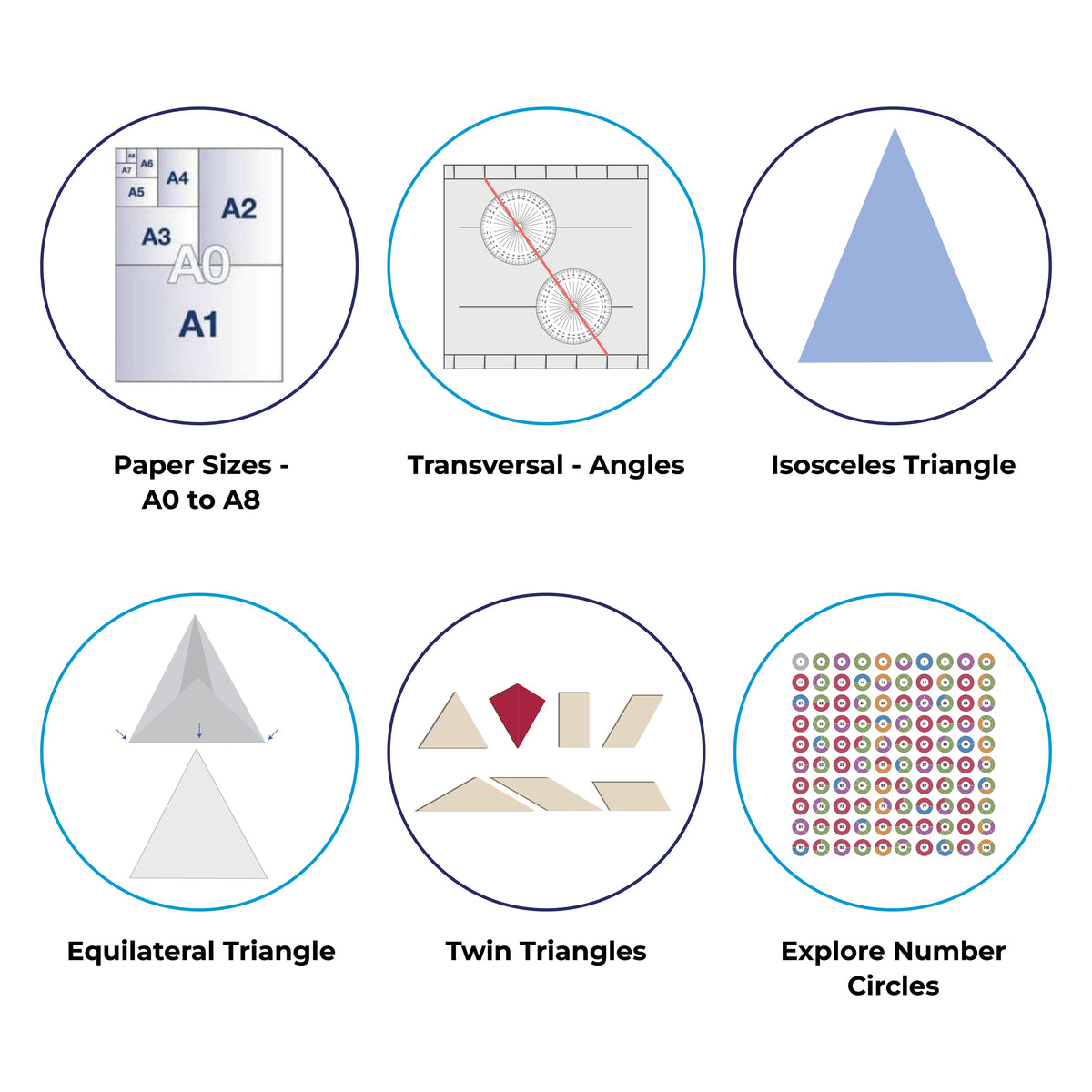
Create, enjoy and learn from ThinkTac's Experiential Science Annual Programme, aligned with the NCERT curriculum, which is fun-filled and can be done safely at the comfort of your home. These do-it-yourself activities are not only cool but also help you better understand what you are learning in your classroom for the year 2024-25. Please note that live facilitation will not be offered; however, in case of any questions or doubts, students can contact us on WhatsApp or by email.
Programme Features:
- Material kit to make six activities will be shipped to your home.
- A activity handbook with DIY guide, hypothesis, observation and inference worksheets is included in the package.
- In case of any questions or doubts, students can contact us on WhatsApp or by email.
- You can join unLab, our online platform, to access videos and additional content
| SL | TACtivity | Concept Covered |
|---|---|---|
| 1 |
Paper Sizes - A0 to A8 |
Ever wondered what the standard paper sizes actually are, and what the names mean? E.g., how is A4 paper different from A5, or what does A0 paper mean? Do the ratios of the sides in each of the different sizes differ? Find out, with this TACtivity, where you use A4 sheets to make the whole range of A-sized papers - A0 to A8! |
| 2 |
Transversal - Angles |
Corresponding angles are formed when a transversal intersects two parallel lines, occupying the same relative positions, and they are congruent. Alternate angles, also known as 'Z-angles,' are formed when a transversal intersects two parallel lines, lying on opposite sides of the transversal, and they are also congruent. In this TACtivity, we use a cotton thread as a transversal line to measure the corresponding and alternate angles formed by intersecting two parallel lines. |
| 3 |
Isosceles Triangle |
An isosceles triangle is a triangle with (at least) two equal sides. This property is equivalent to two angles of the triangle being equal. An isosceles triangle, therefore, has two equal sides and two equal angles. In an isosceles triangle a perpendicular from the vertex joining the equal sides will bisect the third side. In this TACtivity, using an A4 paper, fold it to make an isosceles triangle and verify the conditions. |
| 4 |
Equilateral Triangle |
In geometry, an equilateral triangle is a triangle in which all three sides have the same length. In the familiar Euclidean geometry, an equilateral triangle is also equiangular; that is, all three internal angles are also congruent to each other and are each 60 degrees. In this TACtivity, using an A4 paper, fold it to make an equilateral triangle without using a ruler/protractor/pencil/pen and verify the conditions. |
| 5 |
Twin Triangles |
Congruence means that two shapes have the same size and the same shape. When two figures are congruent, they can be placed exactly on top of each other, matching perfectly in all sides and angles. Understanding congruence helps us compare shapes and discover the properties they share. In this TACtivity, you will use two congruent triangles to create different quadrilaterals. By arranging the triangles in various ways, you will explore which quadrilaterals can be formed and observe their properties. This hands-on activity helps you see how congruent shapes combine and how their sides and angles determine the type of quadrilateral created. |
| 6 |
Explore Number Circles |
Prime numbers are numbers that can be divided only by 1 and themselves. By breaking numbers into their prime factors, we can find the HCF and LCM more easily. In this TACtivity, you will use a prime number circle to spot prime numbers and then use them to find the HCF and LCM of two given numbers through prime factorisation. |