

ThinkTac
Grade VII Science Kit for Children (Class 7) - 6 Hands-on Experiments, NCERT Aligned
Grade VII Science Kit for Children (Class 7) - 6 Hands-on Experiments, NCERT Aligned
For the 2026-27 academic year
Couldn't load pickup availability
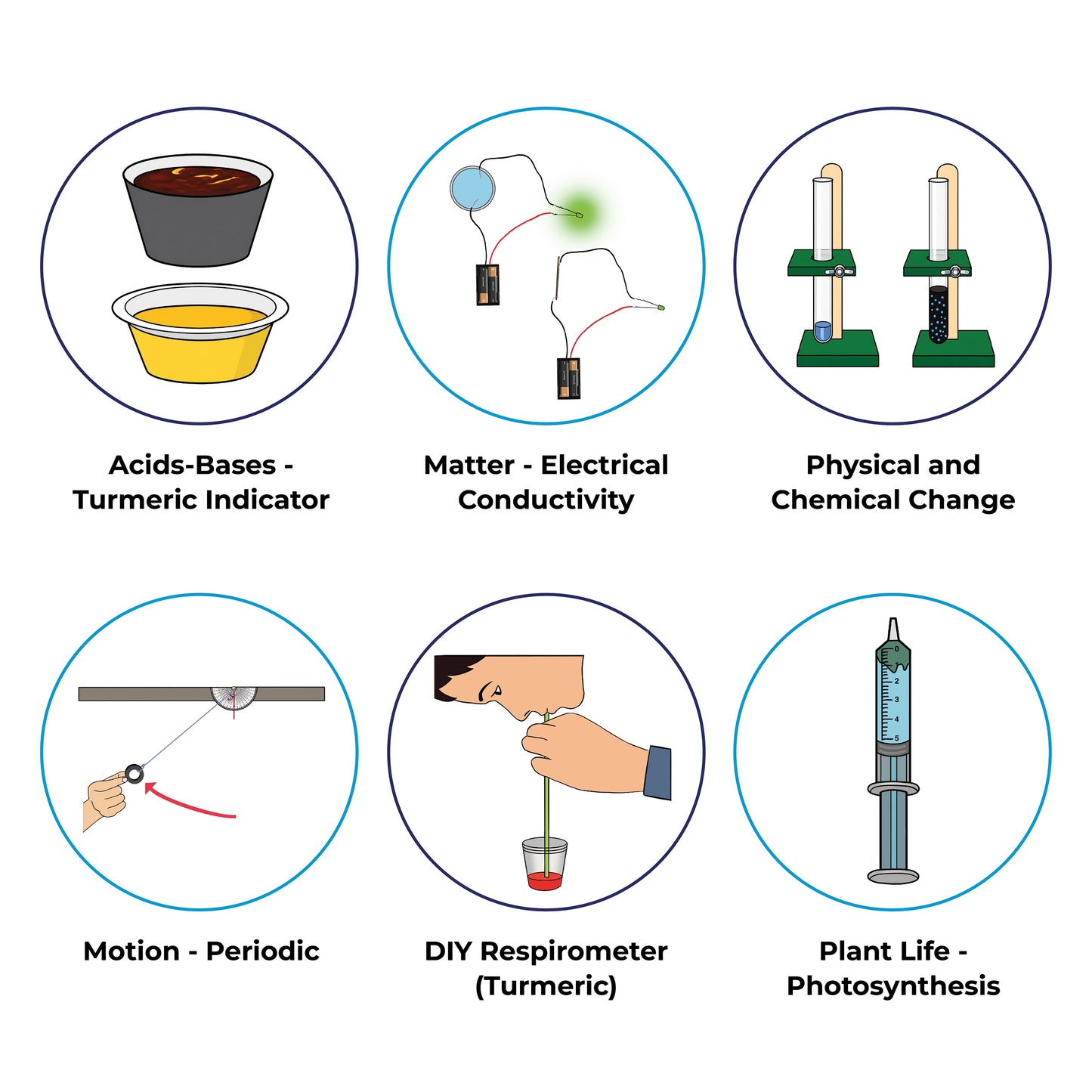
A hands-on science experiment kit for children in Grade VII (Class 7). It has the materials for six do-it-yourself science experiments at home: Acids-Bases - Turmeric Indicator, Matter - Electrical Conductivity, Physical and Chemical Change, Motion - Periodic, DIY Respirometer and Plant Life - Photosynthesis. Every activity follows the NCERT curriculum, and the kit comes with an activity handbook with a step-by-step guide and worksheets for hypothesis, observation and inference. Part of ThinkTac's Annual Science Programme.
Create, enjoy and learn from ThinkTac's Experiential Science Annual Programme, aligned with the NCERT curriculum, which is fun-filled and can be done safely at the comfort of your home. These do-it-yourself activities are not only cool but also help you better understand what you are learning in your classroom for this academic year. Please note that live facilitation will not be offered; however, in case of any questions or doubts, students can contact us on WhatsApp or by email.
Programme Features:
- Material kit to make six activities will be shipped to your home.
- An activity handbook with a DIY guide, hypothesis, observation and inference worksheets is included in the package.
- In case of any questions or doubts, students can contact us on WhatsApp or by email.
- You can join unLab, our online platform, to access videos and additional content.
| SL | TACtivity | Concept Covered |
|---|---|---|
| 1 | Acids-Bases - Turmeric Indicator | There are many wonderful natural acid-base indicators. One such ubiquitous food item in Indian households is turmeric powder. The dazzling yellow of turmeric turns a deep red when exposed to a basic/alkaline substance. However, it remains yellow if the test sample is neutral or acidic. The deep red powder created by exposing turmeric to a basic substance is nothing but vermilion, which is now your natural acid indicator, as it will turn back to yellow (turmeric) when exposed to an acidic solution, but will remain a deep red when exposed to a basic or neutral substance. Enjoy testing various household items, edible and non-edible, for their acidity or alkalinity! |
| 2 | Matter - Electrical Conductivity | Electrical conductivity is the measure of the amount of electrical current a material can carry. A conductor is a material which allows current to flow through it easily whereas an insulator is a material which does not allow the flow of current through it. In this TACtivity, we will set up a circuit using AA cells and an LED, to test the electrical conductivity of different materials used in our daily life. |
| 3 |
Physical and Chemical Change |
What happens when you tear a sheet of paper into pieces? And what if you burned those pieces? In both cases, you would observe a change in the paper's shape, size, or chemical composition. A change in an object's shape or size is called a physical change while a change in its chemical composition is a chemical change. In this TACtivity, we will explore both physical and chemical changes by heating copper sulphate and reacting it with magnesium. |
| 4 |
Motion - Periodic |
In this splendidly simple and iconic TACtivity, you will make a classic pendulum, with a string and weight, used to measure time for centuries and the very basis of our "grandfather" clocks! Moreover, the constant to-and-fro motion, also known as Oscillatory Motion or Simple Harmonic Motion, is a wonderful phenomenon to experience and make measurements on. |
| 5 |
DIY Respirometer (Turmeric) |
Chemical reactions often create a change in colour. Here, we use turmeric as an acid-base indicator to make a simple "respirometer", which can be used to estimate your metabolic rate as you blow into a solution of slaked lime. |
| 6 | Plant Life - Photosynthesis |
Photosynthesis is the core essence of all life on this planet! The ability of plants to use the Sun's energy, water and atmospheric carbon dioxide to produce food and oxygen is the reason other life forms - animals - exist on this planet. In this ingeniously designed TACtivity, we submerge small leaf disc pieces in a syringe filled with sodium bicarbonate solution, which is exposed to sunlight. The solution-filled leaves initially sink; however, as photosynthesis proceeds, oxygen is released into the interior of the leaf, which changes the buoyancy of the leaf disc - causing it to rise. |