

ThinkTac
Grade VIII Annual Math Programme
Grade VIII Annual Math Programme
Couldn't load pickup availability
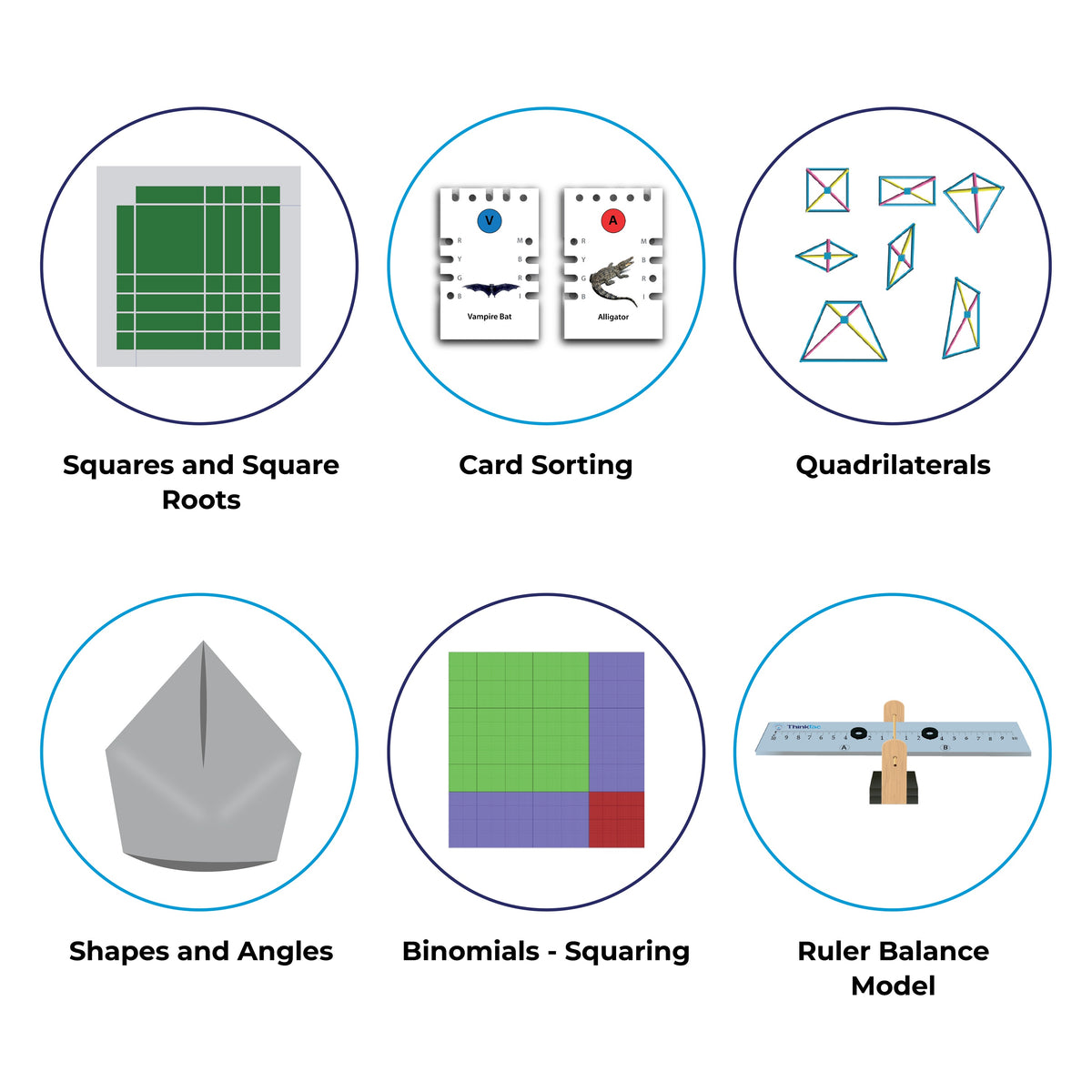
Create, enjoy and learn from ThinkTac's Experiential Science Annual Programme, aligned with the NCERT curriculum, which is fun-filled and can be done safely at the comfort of your home. These do-it-yourself activities are not only cool but also help you better understand what you are learning in your classroom for the year 2024-25. Please note that live facilitation will not be offered; however, in case of any questions or doubts, students can contact us on WhatsApp or by email.
Programme Features:
- Material kit to make six activities will be shipped to your home.
- A activity handbook with DIY guide, hypothesis, observation and inference worksheets is included in the package.
- In case of any questions or doubts, students can contact us on WhatsApp or by email.
- You can join unLab, our online platform, to access videos and additional content
| SL | TACtivity | Concept Covered |
|---|---|---|
| 1 |
Squares and Square Roots |
Squares are the numbers generated after multiplying a value by itself. Whereas, the square root of a number is the value which on getting multiplied by itself gives the original number. Hence, you may consider each as the converse of the other. In this TACtivity, we use algebraic tiles to find the squares and square roots of some given numbers. |
| 2 |
Card Sorting |
Exponents and powers play a crucial role in understanding binary numbers, which form the foundation of digital computing. In binary notation, exponents represent the positions of digits, with each position indicating a power of 2. This system simplifies complex calculations and underpins computer architecture and programming languages. In this TACtivity, we employ card sorting techniques to comprehend binary numbers and their equivalent decimal values through exponents and powers. |
| 3 |
Quadrilaterals |
A quadrilateral is a polygon, which has four sides, four angles and four vertices. In this TACtivity, we explore the different shapes of quadrilaterals, using straw pieces. |
| 4 |
Shapes and Angles |
Paper has been used to make all kinds of geometric shapes for many centuries. In this TACtivity, we make 7 different newspaper caps. For each, we observe and record the shape at each stage of the making of the cap. We also predict and then measure the interior angles of each cap. Are your predictions validated? Did any shape have an interior angle greater than 180 degrees? |
| 5 |
Binomials - Squaring |
Algebraic expressions and identities of the second order are best experienced through the concept of "area". All areas are measured in "square" units, which automatically means you can play around with squares and rectangles to visually experience what at first appear to be abstract algebraic identities. In this TACtivity, with the use of simple squares and rectangular tiles and some colouring pens or crayons, you get to verify some standard algebraic expressions of the second order, by playing with coloured squares and rectangles of different sizes. |
| 6 |
Ruler Balance Model |
What makes a seesaw balance? How can people of different weights play fairly on a seesaw? In this TACtivity, using a ruler as a seesaw and magnets as the weights, we play by placing the objects of various weights at various distances and comparing the quantities of the objects in ratios. |